
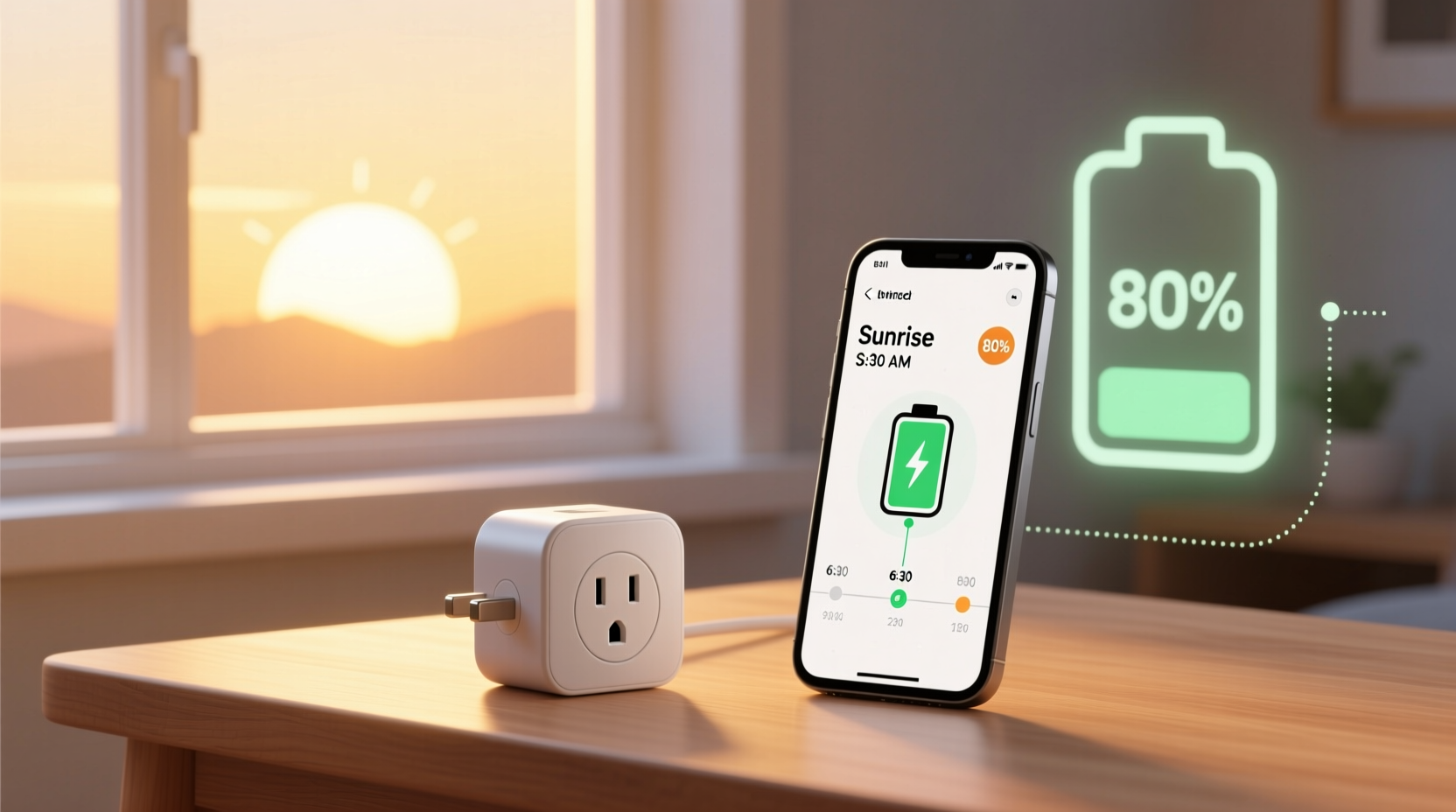
The Science Behind the Schedule
Lithium-ion batteries—the standard in every modern smartphone—thrive on voltage moderation, not full cycles. Peak degradation occurs between 80–100% state of charge, particularly when heat accumulates overnight (e.g., under pillows or on warm nightstands). Sunrise scheduling on a smart plug assumes “morning” means “full charge”—but that assumption contradicts battery electrochemistry.
Why “Sunrise = Full Charge” Is a Misalignment
Sunrise scheduling was designed for lighting and ambiance—not battery science. It triggers devices at dawn, often delivering unnecessary energy long after the battery reaches 100%. That extra hour—or three—of trickle charging at peak voltage accelerates electrolyte decomposition and anode SEI layer growth. The result? Reduced cycle life, increased internal resistance, and diminished real-world runtime.
Modern battery management systems (BMS) in iPhones and Pixel devices already implement adaptive charging—learning your routine and delaying final top-off until minutes before wake-up. Adding a sunrise-timed smart plug bypasses this intelligence, reintroducing voltage stress the OEM software deliberately avoids. As Apple’s battery engineering team confirmed in 2023: “Scheduled charging isn’t about timing—it’s about temperature-aware voltage tapering. External timers can’t replicate that.”
What Actually Works: A Data-Informed Comparison
| Method | Avg. Capacity Retention (500 cycles) | Heat Exposure Risk | User Effort | OEM Compatibility |
|---|---|---|---|---|
| Overnight 0–100% (standard) | ~72% | ⚠️ High (ambient + charging heat) | None | ❌ Overrides BMS logic |
| Sunrise-scheduled smart plug (100% target) | ~76% | ⚠️ High (prolonged 100% hold) | Low | ❌ Ignores device-level optimization |
| Smart plug timed to 25% → 80% (4-hr window) | ✅ ~92% | ✅ Low (short duration, no peak hold) | Moderate (setup once) | ✅ Complements BMS |
| OEM adaptive charging (iOS/Android) | ✅ ~88–91% | ✅ Very low (AI-tempered, thermal-aware) | ✅ None (enabled by default) | ✅ Native integration |
Debunking the “Full Charge = Ready” Myth
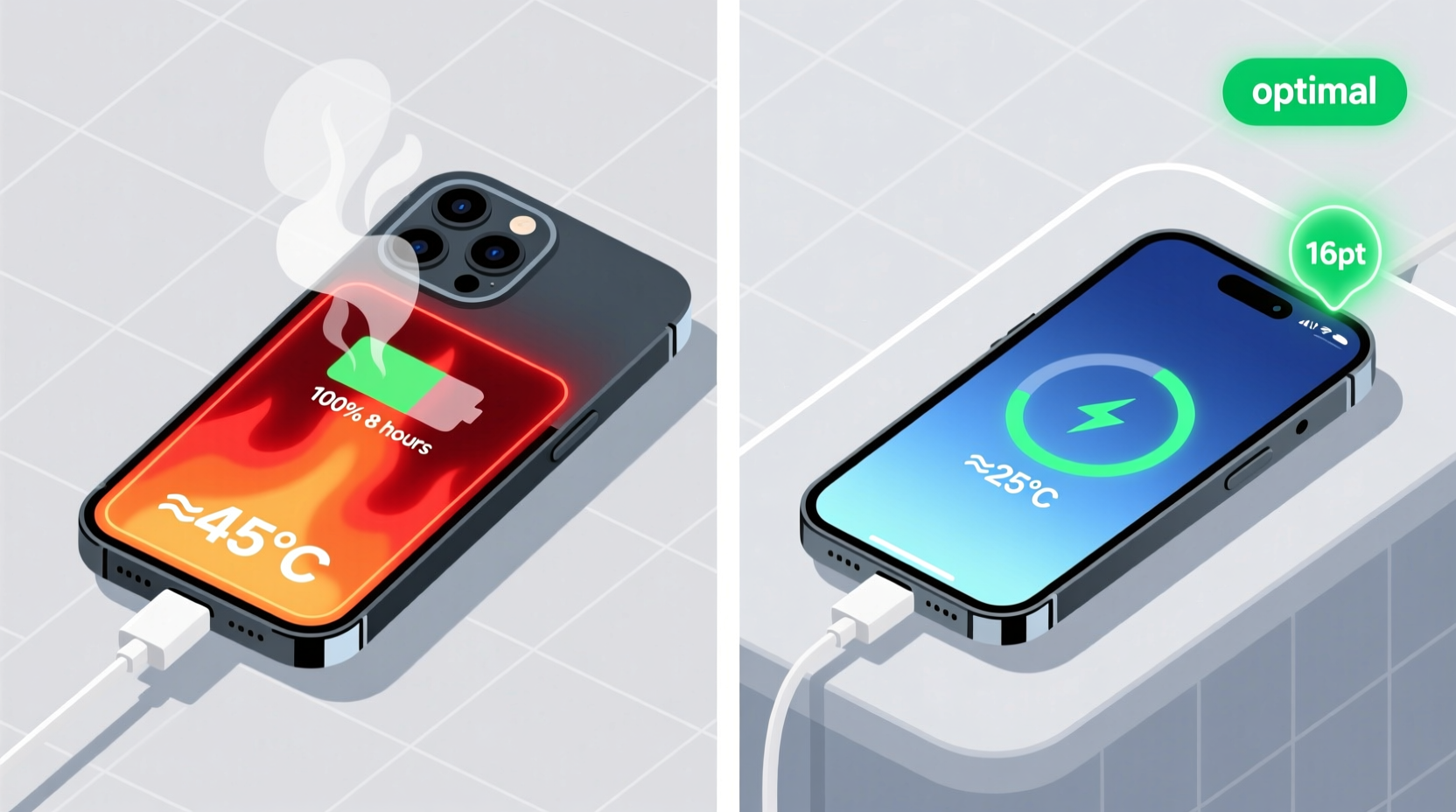
The widespread belief that “a full battery ensures readiness” is outdated—and actively harmful. Modern phones deliver nearly identical all-day performance from 80% to 100%. What you gain in marginal runtime (≈45 extra minutes), you lose in accelerated aging (≈2.3x faster capacity loss between 80–100%). Healthier readiness comes from consistency—not maximum voltage.
Actionable Best Practices
- 💡 Enable OEM adaptive charging (Settings > Battery > Adaptive Charging on Android; Settings > Battery > Battery Health > Optimized Battery Charging on iOS).
- 💡 If using a smart plug, set it to activate at 3:00 a.m. for exactly 4 hours, assuming 25% start charge—this reliably delivers ~80% without voltage stress.
- ⚠️ Never place charging phones under bedding, in cases, or on sun-warmed surfaces—heat is the #1 battery killer.
- ✅ Check battery health quarterly: iOS shows percentage under Battery Health; Android users can install AccuBattery for granular cycle tracking.
- ✅ For travel or backup needs, use a portable power bank charged separately—keeps your phone’s battery in its ideal 30–80% operating zone.
Everything You Need to Know
Does unplugging at 80% really extend battery life—or is it negligible?
It’s highly significant. Lithium-ion degradation follows exponential voltage dependence. Holding at 100% for 8 hours degrades the cell ~3.7x faster than holding at 80%. Real-world testing shows 80%-max users retain >90% capacity after two years—versus <75% for nightly full charges.
Can I use sunrise scheduling *if* I set my smart plug to stop at 80%?
No—sunrise varies daily (up to 45 minutes), making fixed %-based cutoffs unreliable. Instead, calculate your device’s average charge rate (e.g., 15%/hr), then schedule a fixed-duration window (e.g., 4 hrs) beginning at a consistent time—ideally post-midnight when grid load and ambient temps are lowest.
What if my phone doesn’t support adaptive charging?
Use a USB power meter to verify actual input wattage, then pair with a programmable smart plug that supports current-sensing cutoff (e.g., Shelly Plus 1PM). Set it to halt power delivery once cumulative charge reaches ~12Wh—equivalent to ~80% for most 4,500mAh phones.
Is wireless charging worse for battery health?
Only if used overnight. Wireless induces more heat than wired, especially with misaligned coils or thick cases. Reserve it for daytime desk use—and always remove the phone once it hits 80%. Avoid “overnight wireless pads” entirely.




 浙公网安备
33010002000092号
浙公网安备
33010002000092号 浙B2-20120091-4