
The Readability Trade-Off No One Talks About
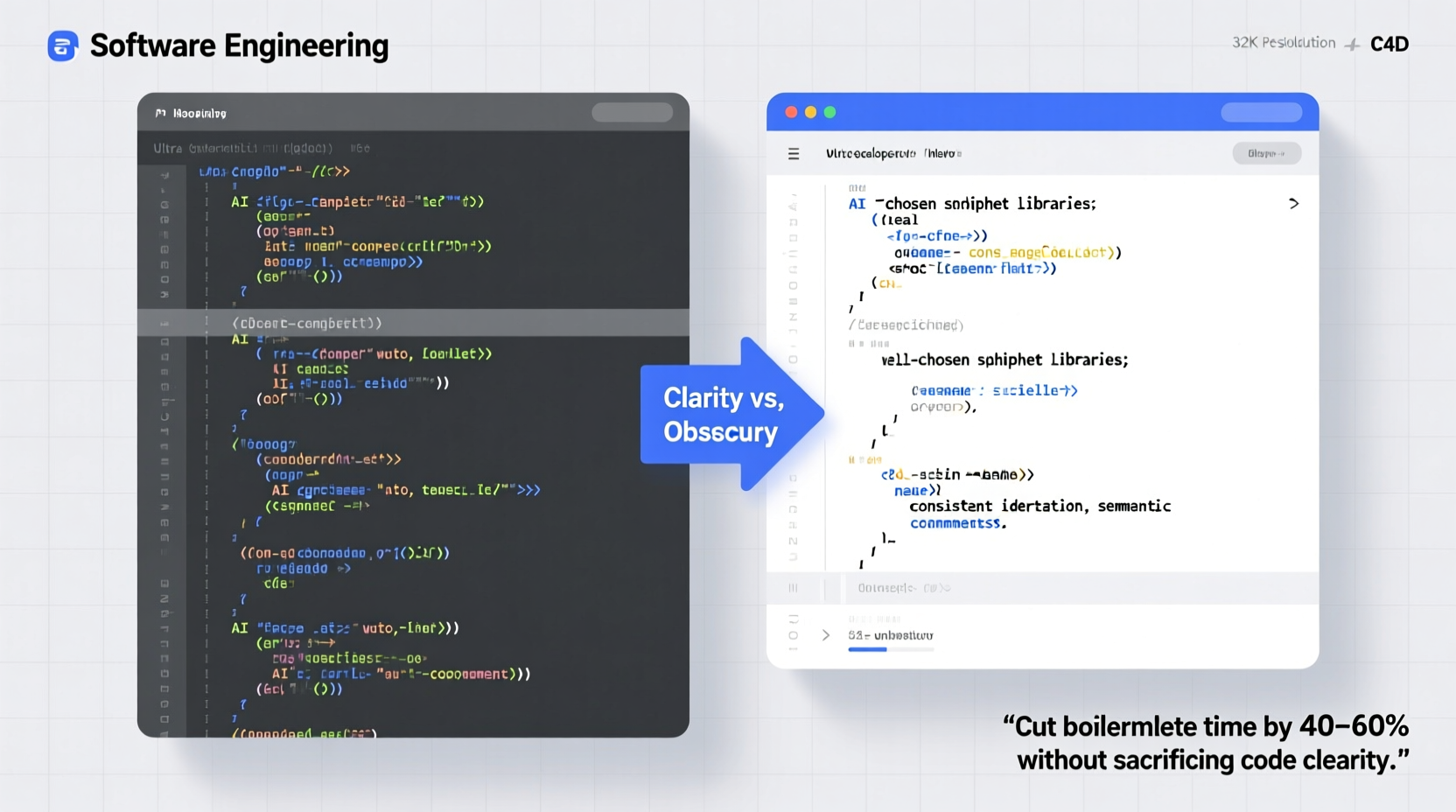
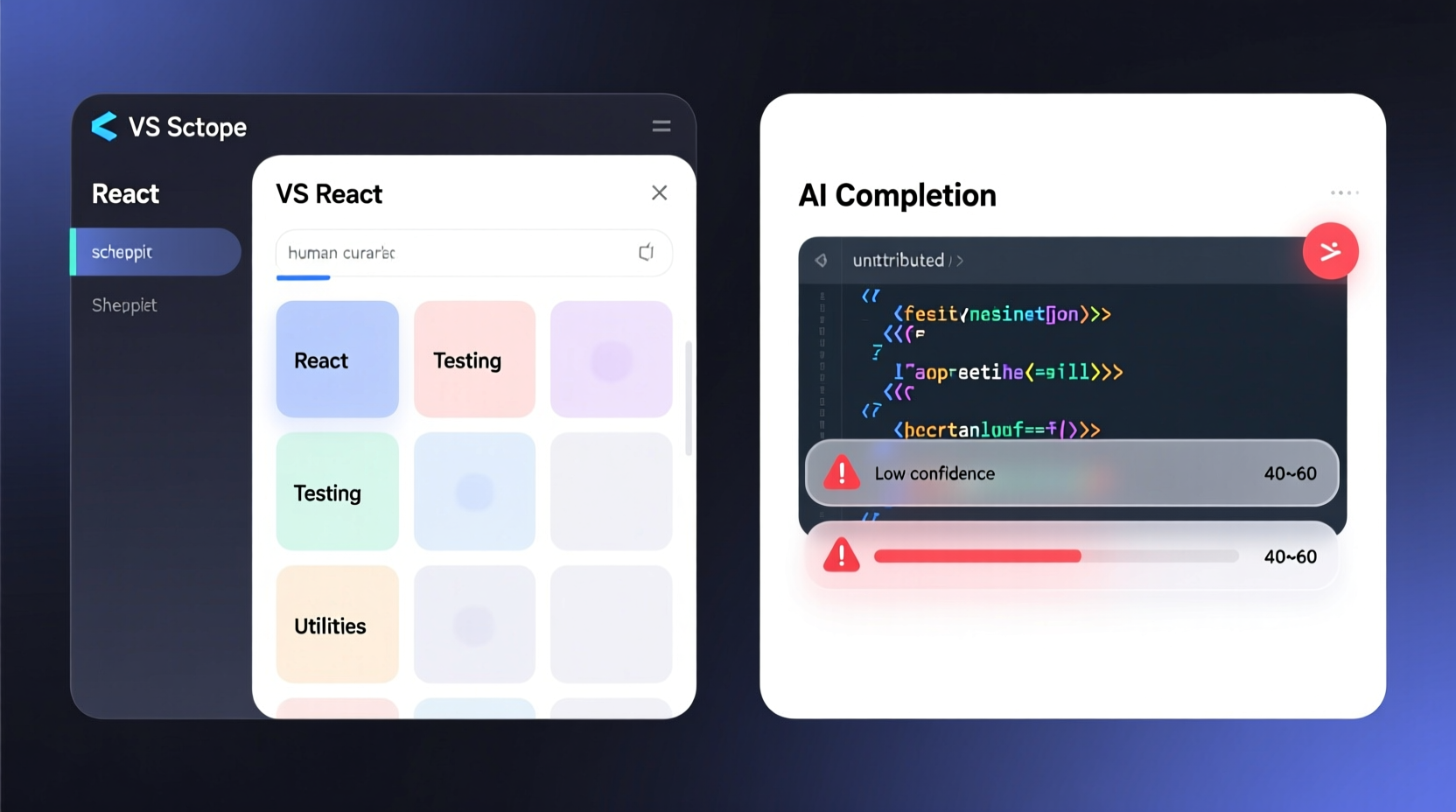
AI code completion tools promise speed—but at a hidden cost to code as communication. When an LLM generates a 12-line utility function inline, developers rarely pause to verify its correctness, edge-case handling, or alignment with existing abstractions. Worse, the output often lacks explanatory comments, uses inconsistent naming, or embeds implicit assumptions about data shape or environment. In contrast, a well-designed snippet is a shared contract: it’s authored once, reviewed, versioned, and named meaningfully (e.g., react-ssr-component or zod-safe-promise). Its behavior is transparent, bounded, and auditable.
Why “Just Use Both” Is a False Compromise
Many teams adopt hybrid workflows—relying on AI for exploratory coding and snippets for standard patterns. But this fractures mental models. Developers toggle between two modes of authorship: one where logic emerges probabilistically, and another where structure is intentional and fixed. The result? Inconsistent abstraction boundaries, duplicated logic disguised as “customization,” and ramp-up friction for new hires who must reverse-engineer AI-generated sections.
“Snippets are intentional scaffolding; AI completions are contextual guessing. In production systems, intentionality—not velocity—is the primary determinant of long-term maintainability.” — 2024 State of Developer Experience Report, Stack Overflow & GitHub Engineering Survey
Comparative Decision Framework
| Criterion | Snippet Library Plugin | AI Code Completion |
|---|---|---|
| Readability impact | ✅ Preserves semantic clarity; explicit structure reinforces team conventions | ⚠️ Often obscures intent; generated logic may lack comments or rationale |
| Onboarding efficiency | ✅ New engineers learn patterns *and* principles simultaneously | ⚠️ Requires reverse-engineering or documentation not guaranteed to exist |
| Maintenance overhead | ✅ Centralized, version-controlled, lightweight | ⚠️ Model drift, prompt fragility, and hallucinated dependencies increase tech debt |
| Team alignment | ✅ Enforces consistency via shared vocabulary and structure | ❌ Encourages divergence; no built-in governance or review mechanism |
Debunking the “More Automation Is Always Better” Myth
The widespread belief that “any automation reduces cognitive load” misreads how developers actually work. Cognitive load isn’t minimized by removing keystrokes—it’s reduced by removing ambiguity. A snippet’s value lies not in saving five seconds, but in signaling *exactly what kind of thing is being created*, what its responsibilities are, and where its boundaries lie. AI completions, by design, prioritize statistical plausibility over conceptual fidelity. They cannot know whether a “quick fix” violates domain invariants—or whether a clever one-liner undermines error resilience.
- 💡 Start small: Convert your three most-used boilerplate patterns into snippets—no AI involved.
- 💡 Name deliberately: Use prefixes like
test-,hook-, orerror-to encode purpose, not just syntax. - ⚠️ Avoid AI-generated snippets: They inherit the model’s blind spots and lack traceability.
- ✅ Document every snippet with a one-sentence “When to use” and “What this guarantees” clause.
- ✅ Run a quarterly snippet audit: delete unused entries, update signatures after major library upgrades, and add examples to your internal docs site.
Everything You Need to Know
Won’t snippets become outdated fast in fast-moving frameworks?
Only if unmanaged. Treat snippets like any other shared dependency: version them alongside your framework upgrades, tag releases, and assign ownership. A snippet for Next.js 13 App Router should be distinct from one for Pages Router—and both should be discoverable by name, not buried in a monolithic file.
Can’t I just train my own AI model on our codebase to avoid these issues?
No—training doesn’t solve the core problem. Even fine-tuned models generate probabilistic outputs, lack deterministic scoping, and cannot enforce architectural constraints (e.g., “this service must never call external APIs synchronously”). Snippets codify constraints; AI approximates patterns.
How do I get teammates to adopt a snippet library instead of relying on AI?
Embed snippets directly into your pull request templates and CI checks. Require snippet usage for certain file types (e.g., all new React components must use react-component). Measure adoption via Git blame and celebrate teams with the highest snippet reuse rate—not fastest typing speed.





 浙公网安备
33010002000092号
浙公网安备
33010002000092号 浙B2-20120091-4